EMDR Therapy
If past experiences still affect how you feel or react today, EMDR can help your brain work through them in a more manageable way.
$140 or
Insurance
Eye Movement Desensitization and Reprocessing (EMDR)
Trauma doesn’t just live in memory — it lives in the nervous system. EMDR helps the brain process experiences that feel unfinished, overwhelming, or hard to put into words.
This work is collaborative, paced, and grounded in choice. We build stability first, then move forward when it’s appropriate for you.
I am EMDR-trained and offer EMDR as part of a broader, trauma-informed approach to therapy.
-
EMDR is often associated with trauma, but it can support a wide range of experiences — especially when something feels stuck despite insight, coping skills, or past therapy.
EMDR may be helpful for:
Trauma and PTSD
Childhood or relational trauma
Distressing memories that still feel emotionally close
Anxiety or panic that feels reactive or hard to control
Negative self-beliefs shaped by past experiences (such as shame or self-blame)
Triggers that cause intense emotional or physical reactions
Grief or loss that feels unresolved
EMDR is not about erasing memories. The goal is to help experiences feel less overwhelming and more integrated, so they have less impact on your day-to-day life.
-
No.
Some sessions focus on preparation, grounding, and building emotional safety. Other sessions focus on processing. We decide together what each session looks like based on your needs, goals, and capacity at the time.
EMDR is one tool — not the entire therapy.
-
Not everyone is ready for EMDR right away — and that’s okay.
EMDR works best when there is enough emotional stability and support in place. Before beginning EMDR, we take time to assess readiness, build coping tools, and make sure the process feels safe and manageable for you.
EMDR may not be appropriate right now for people who are:
experiencing ongoing crises without enough stability
struggling with severe dissociation without support in place
actively unsafe or lacking basic emotional or environmental support
This doesn’t mean EMDR is “off the table.” It often means more preparation is needed first.
We decide together if and when EMDR is a good fit. There is no pressure to start before you feel ready, and there is no failure if EMDR isn’t the right approach for you at this time.
-
When we are actively processing with EMDR, a laptop or desktop computer is required. The larger screen makes it easier to follow the bilateral stimulation comfortably and helps the work feel more stable and manageable.
For sessions focused on discussion, preparation, resourcing, or using other therapeutic approaches, phones are okay.
We’ll talk ahead of time about what each session will focus on so you know what to expect. If EMDR processing is planned, using a computer or laptop helps ensure the session is as effective and supportive as possible.
-
Feeling hesitant or nervous is very common — especially for people who have lived through trauma.
EMDR is never rushed or forced in my practice. We talk openly about your concerns, take time to prepare, and decide together when — or if — EMDR feels appropriate.
Being unsure does not mean you’re not ready. It means you’re listening to your system, and that matters.
-
This is one of the most common fears — and it makes sense.
EMDR does involve gently bringing up difficult experiences, but it is not about re-living trauma or being overwhelmed by it. We spend time building safety, coping tools, and stability before any processing begins.
You remain present, aware, and in control throughout the process. We move at a pace your nervous system can tolerate, and we can pause or slow down at any point.
EMDR can be challenging — but you are not thrown back into the past, and you are not alone while doing this work.
-
EMDR is not easy work — and I won’t pretend it is.
Some people experience strong emotions, body sensations, or fatigue during or after sessions. This is part of the brain doing real processing work. However, this does not mean you’re doing it wrong or that something has gone wrong.
What matters most is that:
you are supported throughout the process
sessions are paced intentionally
we check in often and adjust as needed
Struggle does not mean failure — it means your system is working through something important, with support.
-
No.
EMDR does not require you to describe everything that happened in detail. Many people appreciate this aspect of the approach, especially when talking feels overwhelming or exhausting.
You share only what feels manageable. The focus is on how the experience is stored in the body and brain — not on retelling your story over and over.
-
No — EMDR is not hypnosis.
You are fully awake, aware, and in control during EMDR. You can speak, ask questions, stop at any time, and make choices throughout the session.
While EMDR may feel different from traditional talk therapy, it does not involve losing control, being put into a trance, or having someone “access” your mind. You remain an active participant in your own therapy.
-
If something feels overwhelming, we slow down. If EMDR no longer feels helpful, we pause or shift approaches.
There is no penalty for needing more time, more support, or a different pace. Therapy is not about pushing through — it’s about building trust with yourself and your nervous system.
You don’t have to prove anything to do this work “right.”
The Process

Set the Space
Find a private, comfortable place and use a laptop or desktop computer.
We’ll be working with focused attention and gentle movement. A larger screen helps the process feel smoother and more manageable.

Stay Connected
Join your session through SimplePractice.
This is our main space for talking, grounding, and checking in before during, and after EMDR work.
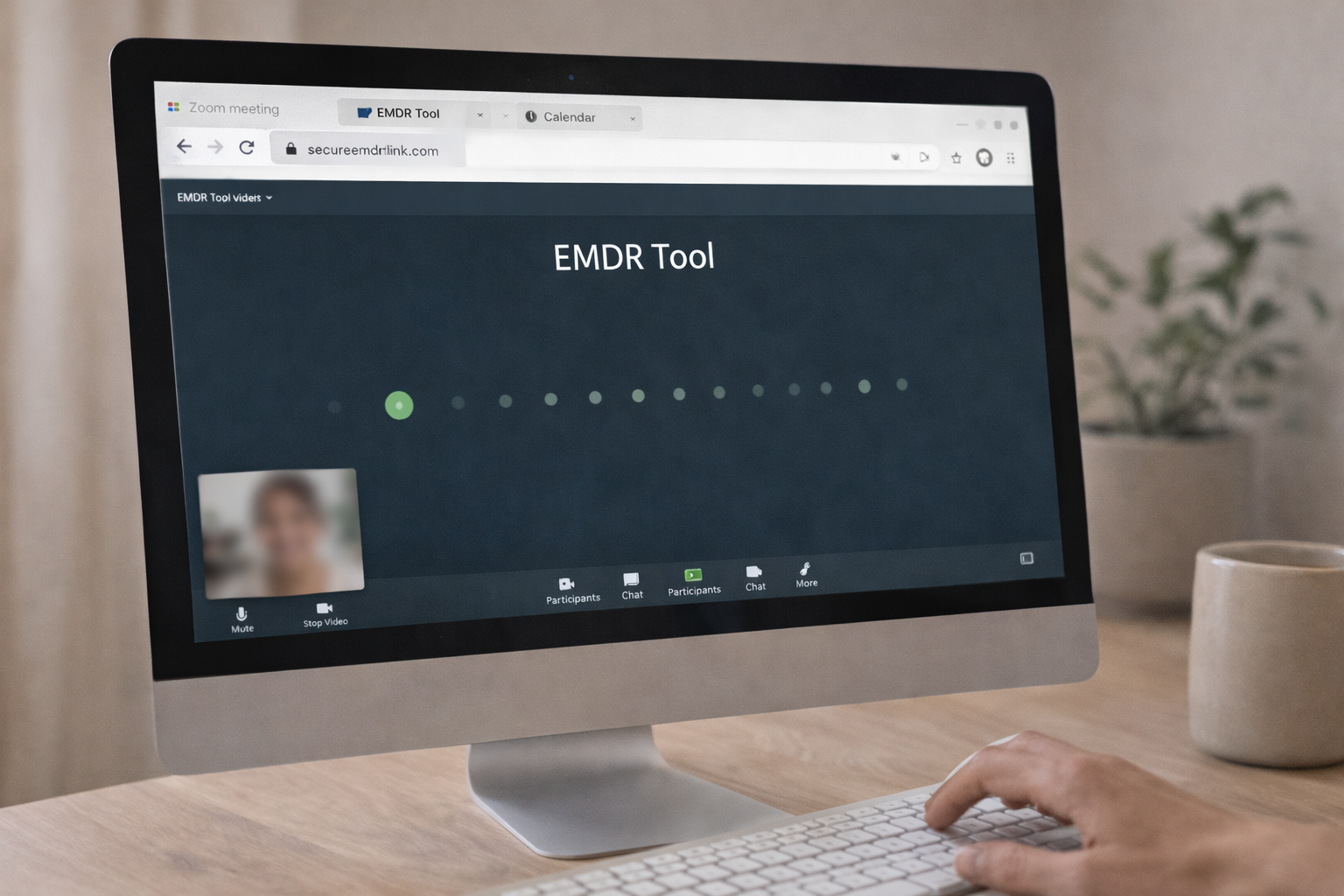
Open the EMDR Tool
I’ll guide you to a secure EMDR link during session.
No account creation. No downloads. Just a second tab and my voice keeping you anchored.

Go at Your Pace
Processing is collaborative, fixable, and never rushed.
We pause, slow down, or stop whenever needed. EMDR can be challenging, but you won’t be doing it alone.
Insurance Carriers